Reducing fraud, waste, and abuse with AI in federal civilian agencies

AI is putting government fraud, waste and abuse (FWA) on notice
The Government Accountability Office estimates the government loses an estimated $233 billion to $521 billion annually to fraud—a number that is likely underestimated due to both underreporting and frauds that are more difficult to detect. As staggering as that number is, it doesn’t cover waste and abuse, which are harder to quantify. A spotlight has been placed on rooting out Fraud, Waste and Abuse (FWA), primarily in the healthcare sector. The Department of Health and Human Services (HHS) estimates that, in FY 2023, 43% of the improper payments made by government programs—over $100 billion worth—were made by the Centers for Medicare and Medicaid Services (CMS). Addressing FWA is a critical effort in the federal government to prevent misallocation of taxpayers’ funds in the magnitude of hundreds of billions of dollars each year. It impacts the quality of the programs. With only so many investigators to review program integrity, some cases for FWA are so well hidden that it is difficult to find.
AI is a critical tool in detecting and minimizing fraud, waste and abuse
Traditionally, FWA is avoided by establishing clear ethical guidelines and implementing robust procedures. It’s detected by cross-referencing databases, monitoring for unusual patterns and responding to tips and whistleblowers. As federal civilian agencies are increasingly challenged to eliminate fraud and do more with less in the DOGE era, AI is becoming an essential tool in the fight. With tight budgets, shrinking staffs, increasingly large volumes of data, outdated systems and high public demand for transparency and accountability, AI bridges the gaps to protect taxpayer dollars, preserve mission integrity and modernize oversight without needing to hire more manpower. Here are just a few of the ways agencies are using AI to combat FWA:
- Anomaly Detection: Finding outliers in large datasets quickly.
- Natural Language Processing (NLP): Scanning and interpreting contracts, claims, case notes, emails.
- Relationship Mapping: Detecting fraud rings and collusion using graph/network analysis.
- Automation at Scale: Auditing thousands of records in seconds, without needing to add more human resources.
How federal civilian agencies are using AI in their FWA programs
From AI and machine learning to detect errors in financial reporting to performing administrative tasks, AI is being used in diverse ways to help organizations run more efficiently, combat crime and protect taxpayer dollars. Here are a couple of use cases to illustrate the trend:
- Department of Homeland Security (DHS). DHS is using AI in diverse ways throughout the Department. It is used at the border to screen cargo and identify anomalies in streaming video. It’s used by airport TSA to verify travelers by facial recognition and screen bags using machine learning object detection. FEMA uses it to assess damage after natural disasters. CISA leverages it to identify cyber vulnerabilities in critical infrastructure. And ICE uses it to identify and rescue victims of child sexual exploitation. To support the Department and its employees internally, DHS has also established its own chatbot and other AI-driven programs for administrative use.
- Centers for Medicare and Medicaid Services (CMS). CMS developed an Innovation Center focused on Wasteful and Inappropriate Service Reduction (WISeR). WISeR leverages enhanced technologies like AI to streamline the prior authorization process and pre-payment reviews to eliminate wasteful care. The program eliminates waste without changing coverage or superseding the judgment of clinicians. CMS also uses AI to detect fraud by analyzing claim histories, identifying billing spikes, detecting irregularities in clinical documentation and flagging inconsistencies in billing practices. These AI models have delivered ROIs measured in billions of taxpayer dollars saved.
- Department of the Treasury. Check fraud has increased nationwide by 385% since the pandemic. To address this increase, the Treasury's Office of Payment Integrity implemented an enhanced process using AI to mitigate check fraud in near real-time. They recovered $375M in FY23 as a result. The IRS will soon be fighting AI-powered fraud with fraud-fighting AI, using the technology to detect tax fraud, cryptocurrency fraud, terrorism funding, identity theft and money laundering. They are currently saving at least $1.3 billion in tax fraud without AI and anticipate that, using AI, that number will grow to offset the billions they lose to fraud annually.
Finding the right AI for the job
Primer is committed to advancing the government’s mission to detect and prevent fraud, waste, and abuse. Our specialized Natural Language Processing (NLP) engine can read and understand unstructured data, opening the door to finding FWA in contracts, claims, case notes, compliance documents and more. Primer’s AI is trusted at the highest levels to flag inconsistencies across complex text inputs, help analysts trace patterns of misuse and abuse and operate confidently and efficiently in some of the most sensitive, secure federal environments. Having a partner who understands your mission is a big part of the job.
Strengthening taxpayer trust
It’s important to understand that FWA is not just a budget issue. It’s a public trust issue. The GAO has issued recommendations that have already resulted in hundreds of billions of dollars in cost savings for the American taxpayer. It is also helping agencies shift from a culture of reactive investigation to proactive prevention. As the funding for modernization and use of AI for FWA expands across the federal government and more savings are seen, the public’s trust will once again begin to grow. If you’d like to hear more about how Primer AI can serve your mission and help you combat Fraud, Waste and Abuse and serve your higher mission better, book a demo and bring along your questions and what ifs.
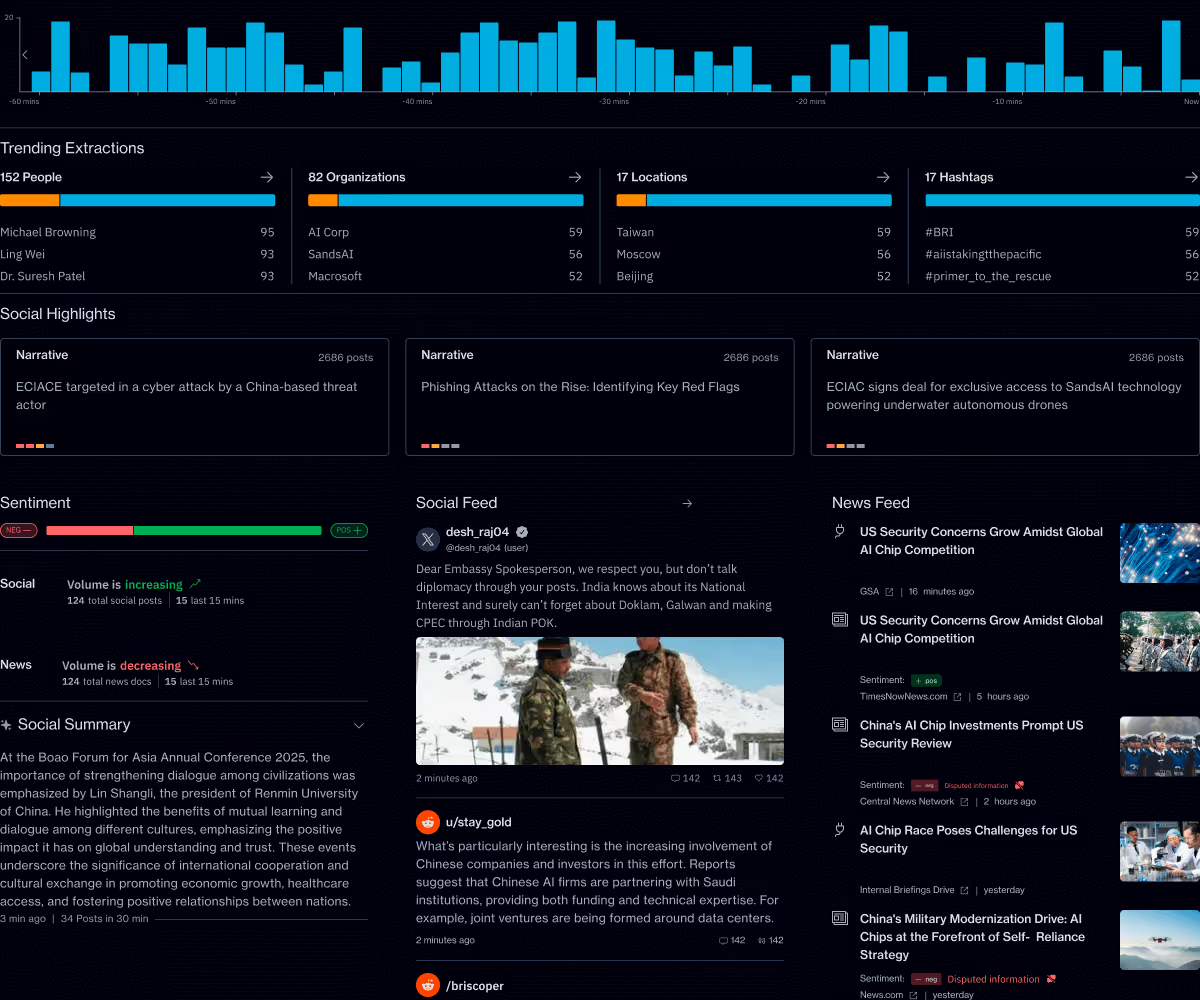
Primer Enterprise
Informed, defensible analysis
Primer Enterprise is a secure AI platform that helps analysts and mission teams across the Intelligence Community, Defense, and Civilian agencies analyze massive volumes of unstructured data. It transforms fragmented reports, proprietary data, and open-source information into structured, traceable insight that supports faster, defensible decision-making.
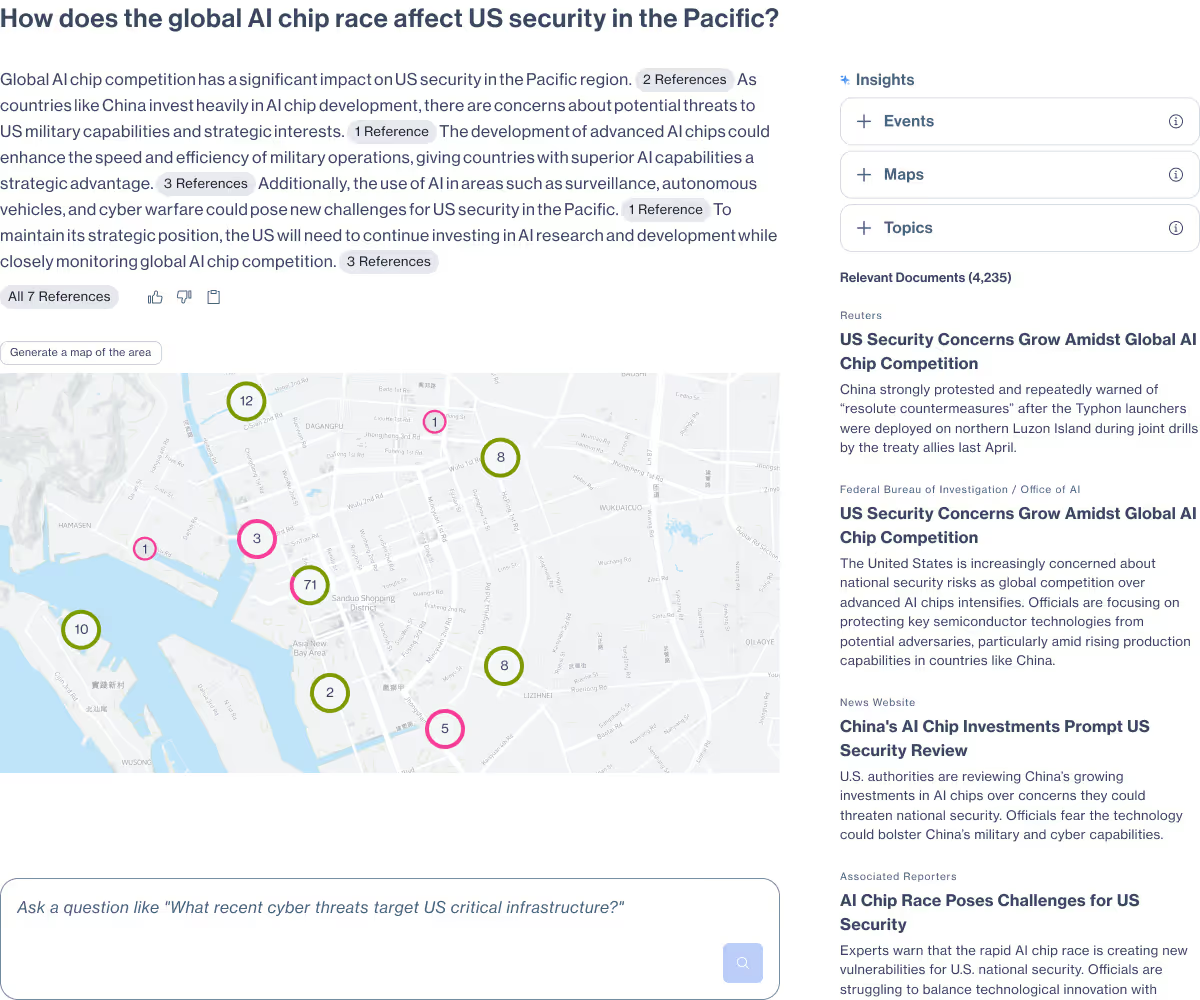
Primer Command
Real-time operational clarity
Primer Command is an AI-powered monitoring platform that helps mission teams keep track of narratives, track evolving topics, and detect emerging threats across global news and social media. It provides real-time visibility into the information environment so leaders can understand events as they unfold.