It all starts with your data






Key features

Foundational ML enrichments
On ingest, Primer standardizes metadata and identifiers, then parses text into entities, claims (derived statements or facts), and semantic chunks with source spans. These features are the building blocks that power each phase of the downstream analysis.
At query time, they deliver precision, speed, and traceability.

Claims extraction
For example, the sentence: “Several unauthorized drone incidents occurred along the U.S.-Mexico border between May 15 and May 30, 2025, involving models such as Dragonfish, Skydio 2+, Black Hornet Nano, and others.” produces the following claims:
- Several unauthorized drone incidents occurred along the U.S.-Mexico border between May 15 and May 30, 2025.
- The incidents involved models such as Dragonfish.
- The incidents involved models such as Skydio 2+.
- The incidents involved models such as Black Hornet Nano.
- The incidents involved other drone models.

Named entity recognition (NER)
The Primer platform uses a pretrained transformer model to identify more than 20 entity types in text with precise character-level source spans that let users validate results against exact snippets of text. These extractions enable fast entity-based filtering, search, and aggregation across the entire corpus without reprocessing.
Entity types: people, organizations, locations, weapons, vehicles, dates, currencies, diseases, devices, animals, quotes, and more

Named entity linking (NEL)
and disambiguation
A step beyond, NER, resolve the mentions of an entity across documents using a multi-tiered contextual matching system.
For people and organization entity types, the system progressively applies document-level alias detection and contextual analysis, with a fine-tuned language model for resolving ambiguous cases.
This links variations like "FBI", "Federal Bureau of Investigation", and "the Bureau" to a single canonical entity in our knowledge base. For all other entity types (weapons, vehicles, and others), the system uses a disambiguation algorithm to group similar mentions, linking "MQ-9 Reaper" with "Reaper drone" across documents.
This multi-stage resolution lets users generate relationship networks and unified entity profiles for people and organizations, while ensuring that entities are consistently aggregated across all types, reducing cognitive load on users.

Fine-Grained Access Control
Primer integrates with customer access controls (ACLs) so users only see what they’re cleared to read, enforcing permissions on ingest, retrieval, and presentation, without duplicating projects and access lists. From extracted entities to summaries and products, the precompute pipeline tags content on ingest and enforces ACLs and markings at every step.

Multi-Model Architecture
Primer combines specialized ML models (embedding models, fine-tuned LMs, deep learning classifiers), and external LLM integrations, each optimized for its specific task rather than forcing everything through a single, general-purpose LLM. This modular architecture delivers particular advantages:
- computed enrichments persist across queries (no redundant processing)
- models swap independently without vendor lock-in
- specialized models provide measurable outputs with accessible weights
- structured extractions enable corpus-wide analytics like entity resolution across millions of documents
The result: superior accuracy and scale at a fraction of the computational cost of a monolithic LLM, with the control and flexibility that mission-critical systems demand.
Our technology is different
Our approach doesn't require exact understanding of the data on ingest, it opens up more data to be searched upon, not limited.
We don't require the overhead and management effort to provision hundreds of projects based on domain, and access for users.
We use the precompute pipeline to accurately tag documents on ingest and connect to your ACL to securely return only available documents based on the user's permissions.
Traditional LLMs vs Primer
Primer Delta
Informed, defensible analysis
Delta is a secure AI platform that helps analysts and mission teams across the Intelligence Community, Defense, and Civilian agencies analyze massive volumes of unstructured data. It transforms fragmented reports, proprietary data, and open-source information into structured, traceable insight that supports faster, defensible decision-making.
Primer Command
Real-time operational clarity
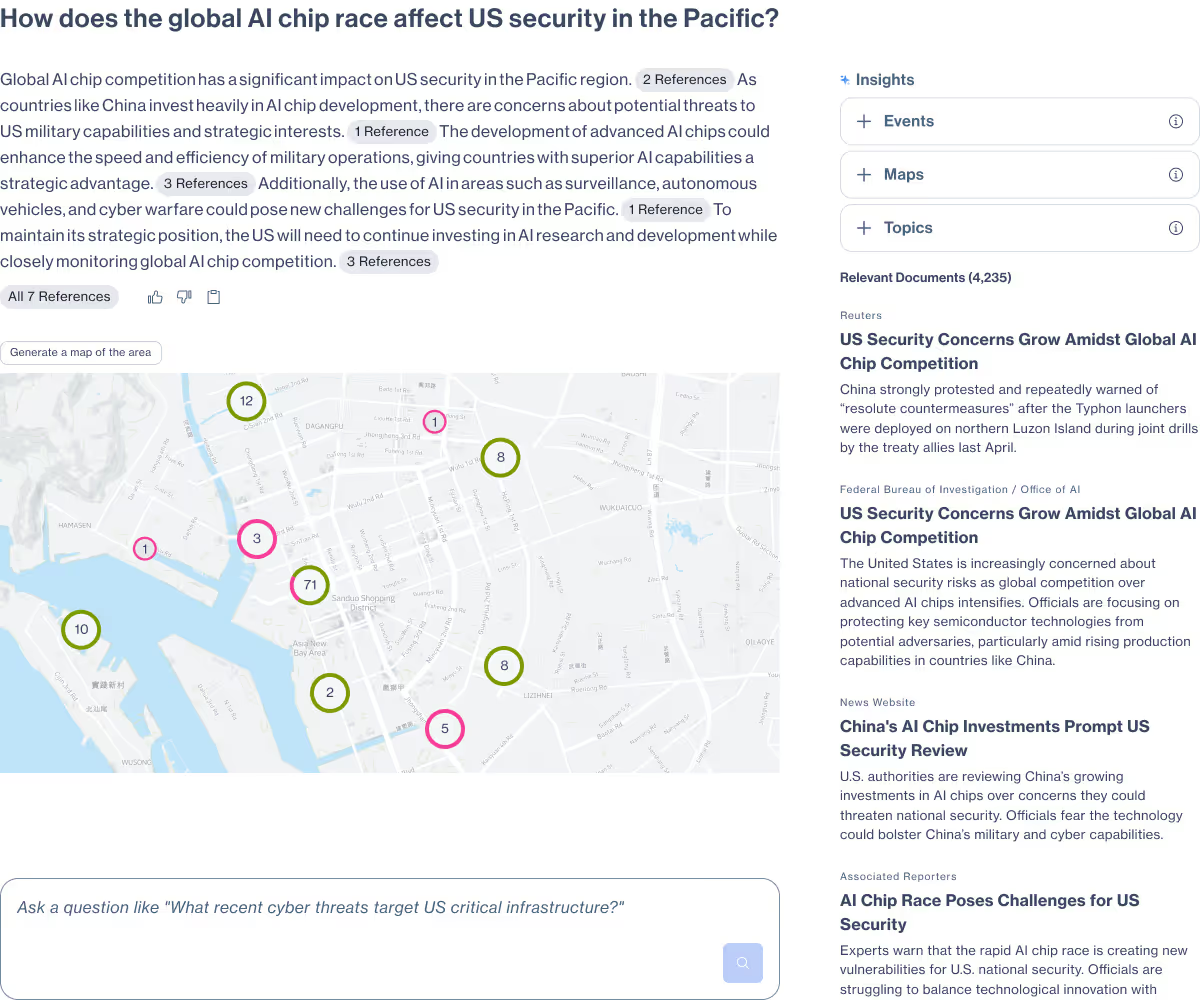
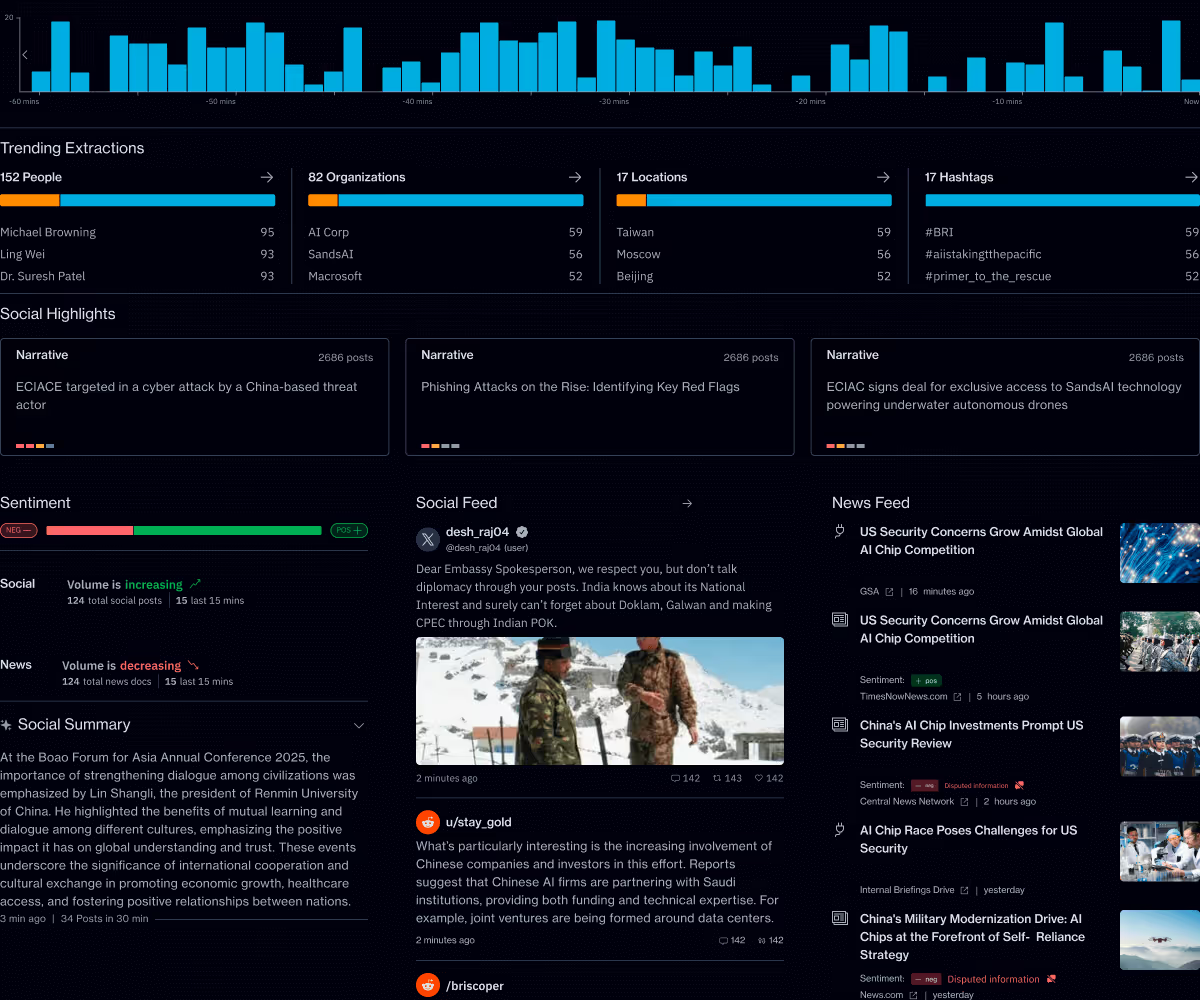
Primer Command is an AI-powered monitoring platform that helps mission teams keep track of narratives, track evolving topics, and detect emerging threats across global news and social media. It provides real-time visibility into the information environment so leaders can understand events as they unfold.
Primer API
AI in your systems
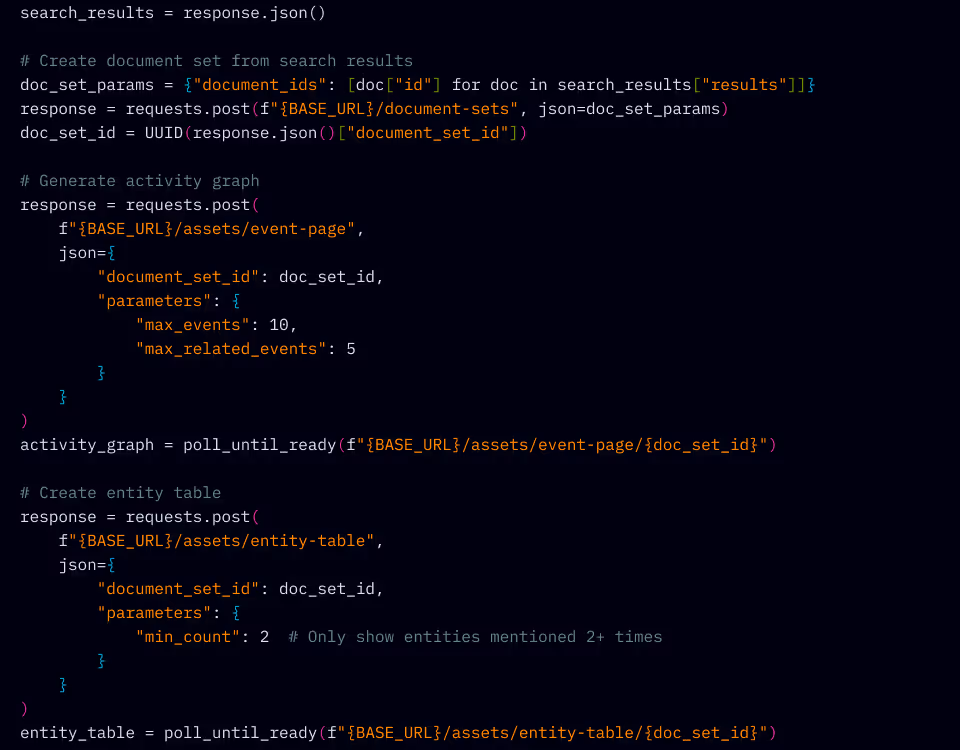
The Primer API brings Primer’s analytic capabilities directly into your existing systems and workflows. Teams can embed advanced search, advanced extractions, AI-assisted analysis, claim-level verifications, and source-grounded summaries into mission applications to accelerate knowledge discovery, analysis workflows, deep research, situational awareness, and reporting.
Security compliance and certifications