What the Primer Enterprise API can do for you
- Search large corpora of documents to return either the full content or aggregated statistics.
- Freeze scope into Document Sets so all downstream analysis runs on a stable, reproducible set of content.
- Run asynchronous Assets, then poll and retrieve the results
- Narratives & Themes
Use lookup to cluster claims into narratives, profile to create concise summaries, graphs to reveal narrative evolution, and themes to group narratives/claims into hierarchical topics and synthesize cross-narrative summaries. - Entities Lookup and disambiguate entities
Generate cited summaries, surface affiliations and quotes, and map related entities and network connections across documents. - Targeted Sentiment
Get a stance for each entity (positive, neutral, negative) with pointers to the exact supporting spans of text in each document, optimized for small batch inputs. - Events & Map extractors
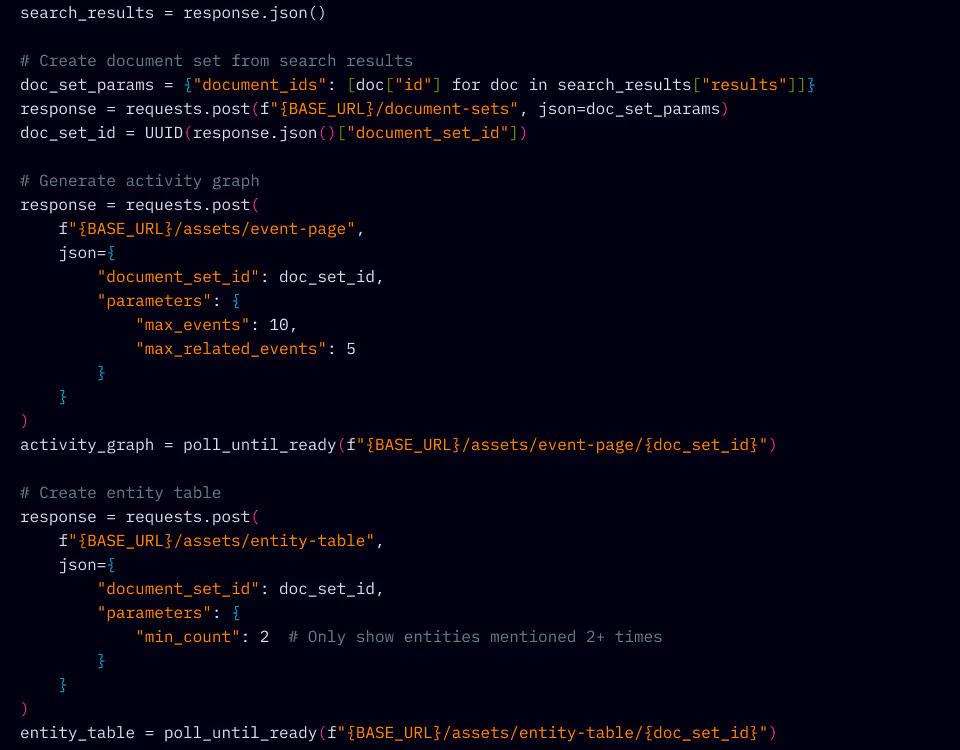
When available, extract activities and points of interest, attach geospatial context for mapping, and include links back to the source document
Key endpoints

Search
Start with Search when you’re still shaping the problem.
- Use
POST /v3/search/documentswhen you need full records (titles, text, metadata) to inspect or pass along. - Use
POST /v3/search/aggregationswhen you only need counts, facets, and quick "how big/how often" signals to steer filters and UI. Returns no documents, just metrics. If you'll run downstream analyses, freeze scope into a Document Set so later assets operate over a stable, reproducible body of content.

Document Sets
Use a Document Set to freeze the scope so every downstream asset runs over the same content. You can create one in two common ways:
- From search terms —
POST /v3/document-setswith asearch_request. The response returns adocument_set_idyou’ll pass to assets. - From raw text —
POST /v3/document-setswith araw_textsarray of strings. Each string is treated as one document in the set. Not all endpoints support raw text, so check the documentation for the individual endpoints.
Why it matters: with a fixed document_set_id, assets are deterministic and auditable, rather than chasing a moving search window.
You can programmatically list your sets later via GET /v3/document-sets and inspect basic metadata (name, created_at).

Narratives and Themes
These endpoints help you move from "a heap of articles" to "what claims are being made, how they group, and how they evolve."
- Narratives — Combine related claims into narrative-level assets with LLM-generated titles, date-aware summaries, citations back to source chunks, and per-entity sentiment so you can inspect how a specific storyline is supported across documents.
- Themes — Automatically cluster extracted claims into narratives and then higher-level themes so you can see the major topics, perspectives, entities, and time ranges that structure a document set.
- Theme Sets — Generate theme-level titles and summaries for curated groups of narratives, reusing their titles and summaries to synthesize an overarching perspective for the cluster you care about, rather than one discovered automatically.
Tip: Treat these as asynchronous assets: create, poll until complete, then fetch results. This keeps calls responsive and lets you orchestrate multiple analyses in parallel.

Entities
Move from "who is this?" to "show me evidence." These endpoints help you discover canonical IDs, build a reusable lookup, and then generate cited facts, affiliations, and quotes over your scoped body of content.
- Find canonical IDs (Knowledge Base search)
GET /v3/knowledge-base/entities-search- Fuzzy, alias-aware search over the NEL (named entity linking) KB. Filter by
entity_types, paginate with 1-basedpageandpage_size(max 100). Results are relevance-ranked.
- Build the foundation (Entity Lookup asset)
POST /v3/assets/entity-lookup- Creates a comprehensive lookup of entities and sentence-level co-mentions for your Document Set; many downstream entity calculators depend on this asset. Requires
document_set_id. Read results withGET /v3/assets/entity-lookup/{asset_id}/results(paginated; up to 1000 items/page) to fetchentities,relationships, and context.
- Summarize with citations (Entity Summary)
POST /v3/assets/entity-summary- Generates a concise, evidence-linked sentence about an entity (or an entity pair) with structured
references. If you don’t pass anentity_lookup_asset_id, one is auto-created.
- Extract affiliations (Entity Affiliations)
POST /v3/assets/entity-affiliations- Pulls roles/positions/org relationships and returns per-document sentence-level citations. Depends on Entity Lookup (auto-created if missing). Results are paginated (asset results endpoints typically allow large pages, for example, up to 1000).
- Attribute quotes (Entity Quotes)
POST /v3/assets/entity-quotes- Finds quoted text and attributes it to the target entity, returning document IDs, sentence content, and character spans. Depends on Entity Lookup (auto-created if missing). Read with
GET /v3/assets/entity-quotes/{asset_id}/results(paginated).

Targeted Sentiment
- Targeted Sentiment – Analyze up to 20 short documents from a Document Set to extract entities, attach positive / neutral / negative stance labels, and return character spans for each mention, making it easy to rapidly triage per-entity sentiment in inbox-sized batches.
- Targeted Sentiment Counts – Run the same entity-level sentiment analysis but aggregate all positive, neutral, and negative mentions per entity across up to 20 documents, returning grouped spans so you can see not just stance but how often each sentiment occurs.
Looking for a user-facing platform?
Primer Delta
Informed, defensible analysis
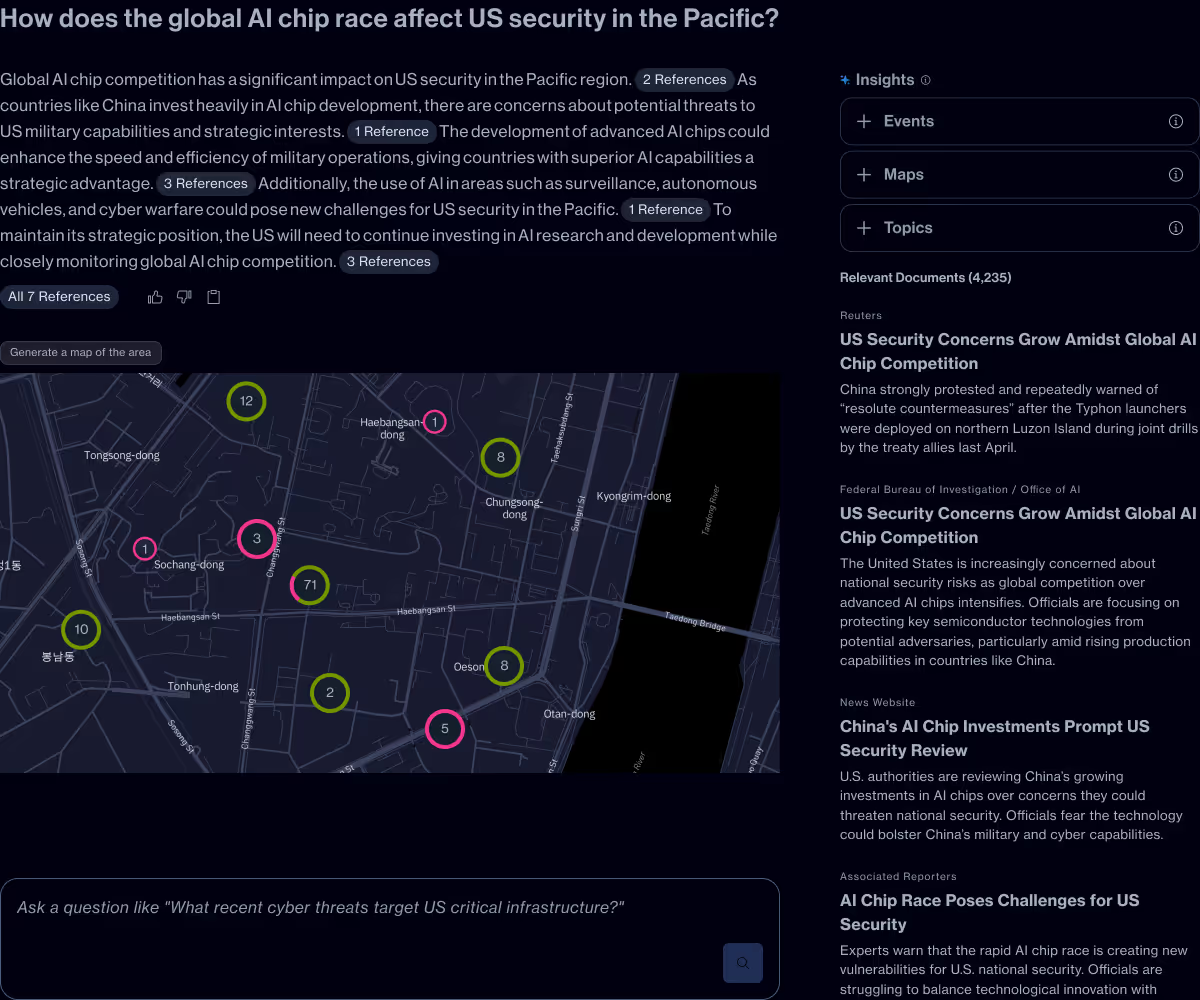
Delta is a secure AI platform that helps analysts and mission teams across the Intelligence Community, Defense, and Civilian agencies analyze massive volumes of unstructured data. It transforms fragmented reports, proprietary data, and open-source information into structured, traceable insight that supports faster, defensible decision-making.
Primer Command
Real-time operational clarity
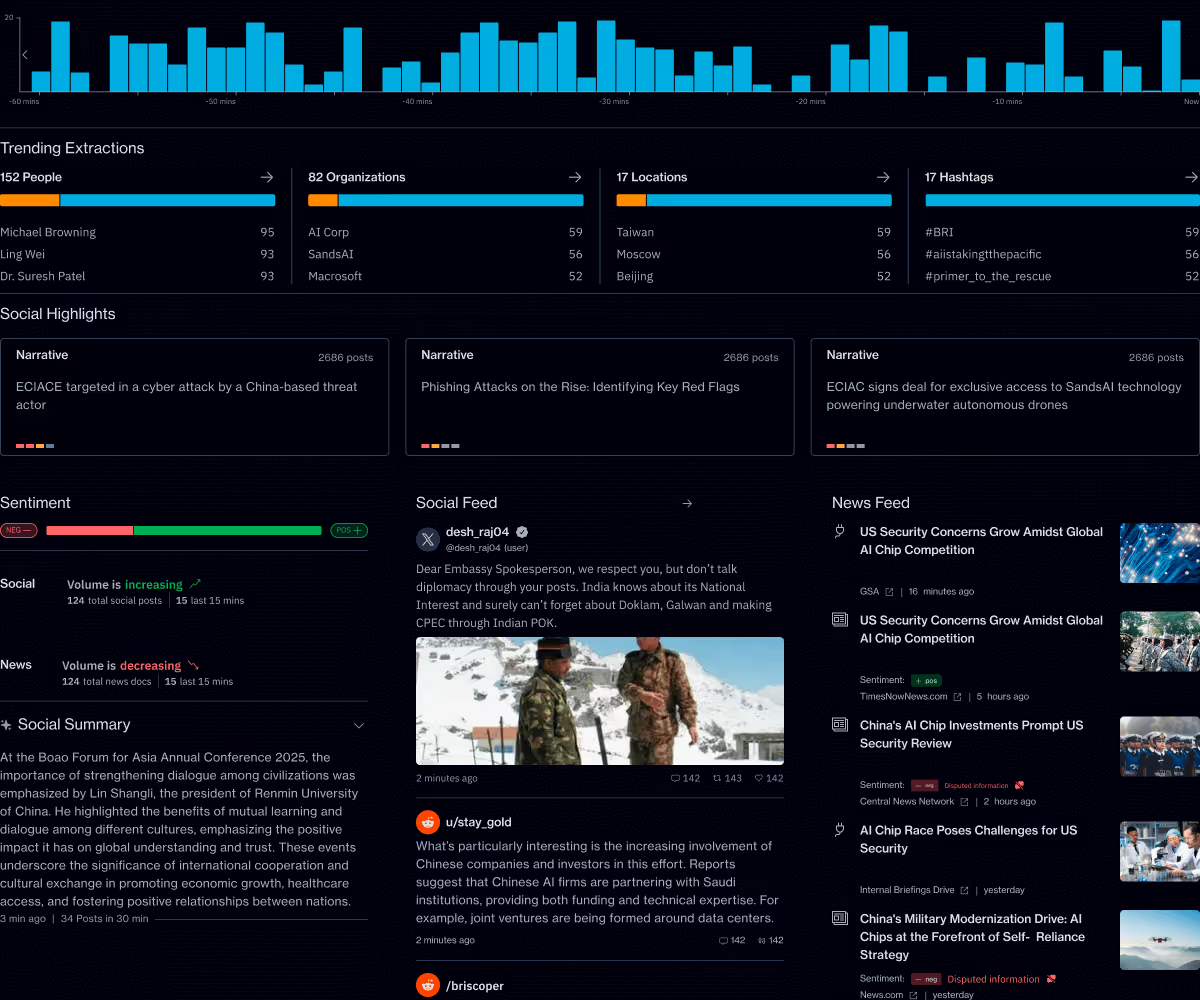
Primer Command is an AI-powered monitoring platform that helps mission teams keep track of narratives, track evolving topics, and detect emerging threats across global news and social media. It provides real-time visibility into the information environment so leaders can understand events as they unfold.
Government Solutions
We have solutions to empower decisions across defense, intelligence, & federal civilian agencies.




Security compliance and certifications



The technology behind Primer
Primer combines agentic AI, natural language processing, advanced information retrieval, powerful data visualizations, and mission-ready infrastructure to help teams make sense of complex information environments. The platform transforms unstructured data into structured context so mission teams can search, explore, and act on insights with confidence.